Chi-Square Distribution

 Chi-Square Distribution:

  • Definition: The Chi-Square Distribution is a continuous probability distribution that arises in statistics. It is commonly used to model the distribution of the sum of the squares of k independent standard normal random variables, where k is known as the degrees of freedom (df). It's denoted as χ2(df).


  • Probability Density Function (PDF): The PDF of the Chi-Square Distribution is defined as:

    f(x;k)=12k/2Γ(k/2)x(k/2)1ex/2

    Where:

    • x is the random variable.
    • k is the degrees of freedom.
    • Γ(k/2) is the gamma function evaluated at k2.

  • Mean and Variance: The mean of the Chi-Square Distribution is k, and the variance is 2k.


  • Graphical Representation:

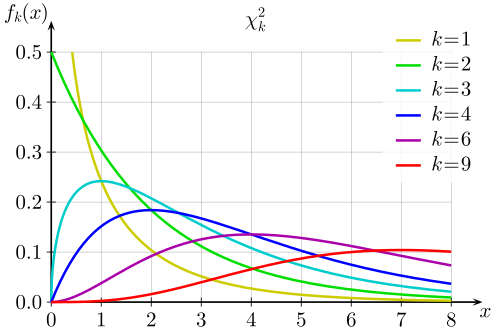
    Here's a probability density function (PDF) plot of the Chi-Square Distribution for various degrees of freedom (k):

    Chi-Square Distribution

    In this graph, you can see the PDF for different values of k. As k increases, the Chi-Square Distribution becomes more symmetric and approaches a normal distribution.


  • Use Cases:

    • Hypothesis Testing: The Chi-Square Distribution is commonly used in hypothesis testing, especially in tests of independence and goodness of fit.
    • Confidence Intervals: It is used to construct confidence intervals for population variances.
    • Statistical Inference: The Chi-Square test statistic is used to determine if observed data fits an expected distribution.

The Chi-Square Distribution plays a crucial role in various statistical tests and is fundamental in the field of inferential statistics. It is particularly useful when dealing with categorical data and making inferences about population variances.

Comments

Popular posts from this blog

What is Tensor Parallelism and relationship between Buffer and GPU

  Tensor Parallelism in GPU Tensor parallelism is a technique used to distribute the computation of large tensor operations across multiple GPUs or multiple cores within a GPU .   It is an essential method for improving the performance and scalability of deep learning models, particularly when dealing with very large models that cannot fit into the memory of a single GPU. Key Concepts Tensor Operations : Tensors are multidimensional arrays used extensively in deep learning. Common tensor operations include matrix multiplication, convolution, and element-wise operations. Parallelism : Parallelism involves dividing a task into smaller sub-tasks that can be executed simultaneously. This approach leverages the parallel processing capabilities of GPUs to speed up computations. How Tensor Parallelism Works Splitting Tensors : The core idea of tensor parallelism is to split large tensors into smaller chunks that can be processed in parallel. Each chunk is assigned to a different GP...

Data Wrangling vs EDA

  Aspect Data Wrangling (Data Preprocessing) Exploratory Data Analysis (EDA) Objective Prepare raw data for modeling by cleaning, transforming, and formatting it appropriately. Explore and understand the data to gain insights, identify patterns, and make decisions on data handling and modeling. Order Typically performed as a preliminary step before EDA. Usually conducted after data wrangling to further investigate data characteristics. Data Handling Focuses on data cleaning, filling missing values, encoding categorical variables, and scaling features. Involves data visualization, statistical analysis, and summary statistics to uncover patterns, relationships, and anomalies. Techniques Techniques include imputation, outlier detection, feature scaling, and one-hot encoding. Techniques include histograms, scatter plots, box plots, correlation matrices, and descriptive statistics. Data Transformation Involves structural changes to the dataset, such as feature engineering, data normaliz...

What's replicated, what's not?

Logged operations are replicated. These include, but are not limited to: DDL DML Create/alter table space Create/alter storage group Create/alter buffer pool XML data. Logged LOBs Not logged operations are not replicated. These include, but are not limited to: Database configuration parameters (this allows primary and standby databases to be configured differently). "Not logged initially" tables Not logged LOBs UDF (User Defined Function) libraries. UDF DDL is replicated. But the libraries used by UDF (such as C or Java libraries)  are not replicated, because they are not stored in the database. Users must manually copy the libraries to the standby. Note: You can use database configuration parameter  BLOCKNONLOGGED  to block not logged operations on the primary.