
Now AWS ELB will come with Static IP Address


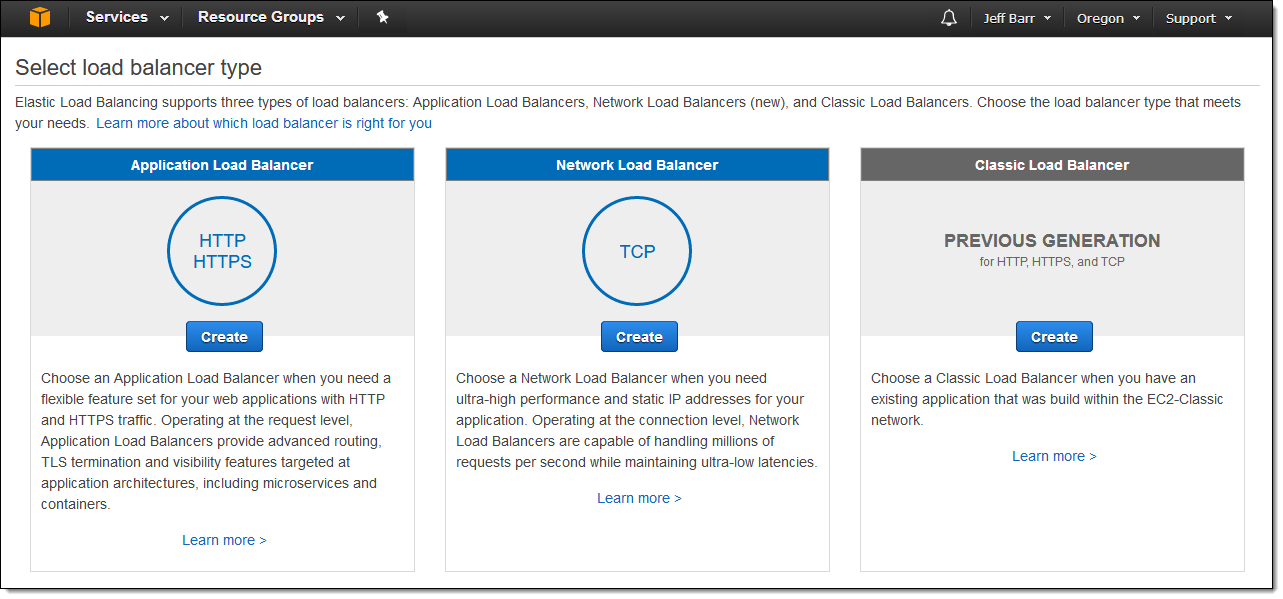
AWS announced Network Load Balancer for the Elastic Load Balancing service designed to handle millions of requests per second while maintaining ultra-low latencies. This new load balancer is optimized to handle volatile traffic patterns while using a single static IP address per Availability Zone.


Static IP Addresses – Each Network Load Balancer provides a single IP address for each VPC subnet in its purview. If you have targets in a subnet in us-west-2a and other targets in a subnet in us-west-2c, NLB will create and manage two IP addresses (one per subnet); connections to that IP address will spread traffic across the instances in the subnet. You can also specify an existing Elastic IP for each subnet for even greater control. With full control over your IP addresses, Network Load Balancer can be used in situations where IP addresses need to be hard-coded into DNS records, customer firewall rules, and so forth.

Comments

Popular posts from this blog

Error: could not find function "read.xlsx" while reading .xlsx file in R

Got this during the execution of following command in R > dat Error: could not find function "read.xlsx" Tried following command > install.packages("xlsx", dependencies = TRUE) Installing package into ‘C:/Users/amajumde/Documents/R/win-library/3.2’ (as ‘lib’ is unspecified) also installing the dependencies ‘rJava’, ‘xlsxjars’ trying URL 'https://cran.rstudio.com/bin/windows/contrib/3.2/rJava_0.9-8.zip' Content type 'application/zip' length 766972 bytes (748 KB) downloaded 748 KB trying URL 'https://cran.rstudio.com/bin/windows/contrib/3.2/xlsxjars_0.6.1.zip' Content type 'application/zip' length 9485170 bytes (9.0 MB) downloaded 9.0 MB trying URL 'https://cran.rstudio.com/bin/windows/contrib/3.2/xlsx_0.5.7.zip' Content type 'application/zip' length 400968 bytes (391 KB) downloaded 391 KB package ‘rJava’ successfully unpacked and MD5 sums checked package ‘xlsxjars’ successfully unpacked ...

What is the benefit of using Quantization in LLM

Quantization is a technique used in LLMs (Large Language Models) to reduce the memory requirements for storing and training the model parameters. It involves reducing the precision of the model weights from 32-bit floating-point numbers (FP32) to lower precision formats, such as 16-bit floating-point numbers (FP16) or 8-bit integers (INT8). Bottomline: You can use Quantization to reduce the memory footprint off the model during the training. The usage of quantization in LLMs offers several benefits: Memory Reduction: By reducing the precision of the model weights, quantization significantly reduces the memory footprint required to store the parameters. This is particularly important for LLMs, which can have billions or even trillions of parameters. Quantization allows these models to fit within the memory constraints of GPUs or other hardware accelerators. Training Efficiency: Quantization can also improve the training efficiency of LLMs. Lower precision formats require fewer computati...

What is Tensor Parallelism and relationship between Buffer and GPU

  Tensor Parallelism in GPU Tensor parallelism is a technique used to distribute the computation of large tensor operations across multiple GPUs or multiple cores within a GPU .   It is an essential method for improving the performance and scalability of deep learning models, particularly when dealing with very large models that cannot fit into the memory of a single GPU. Key Concepts Tensor Operations : Tensors are multidimensional arrays used extensively in deep learning. Common tensor operations include matrix multiplication, convolution, and element-wise operations. Parallelism : Parallelism involves dividing a task into smaller sub-tasks that can be executed simultaneously. This approach leverages the parallel processing capabilities of GPUs to speed up computations. How Tensor Parallelism Works Splitting Tensors : The core idea of tensor parallelism is to split large tensors into smaller chunks that can be processed in parallel. Each chunk is assigned to a different GP...